Friday, January 30, 2015

Peripatetic Science

Some things you don't really fully realize until they are all put together in front of your face. Filling out some (exceedingly tedious) forms today, I had to write down all of the foreign countries that I have visited recently, and apparently, over the past five years I have gone abroad 27 times, to 14 different countries.  The vast majority of that travel has been for scientific meetings of one sort or another, and mostly to various locations in Western Europe.

I know that I travel a good bit for science, and part of me looks at that number and says, eh, that's only about once every quarter.  The other part of me, the part that remembers a quiet childhood growing up in Maine, almost never traveling more than a few hours drive from home, looks at those numbers in astonishment.  It means that I have grown up to become one of those strange frequent fliers, for whom an airport is just a normal part of life, and I suppose that is how it will continue to be for as long as I am a practicing scientist.

I like this life, but sometimes it helps to remember how foreign it is to many others, and even my own younger self, who not only didn't know I would end up living such a life, but never even thought about the possibility.

Sunday, December 14, 2014

Discovering Luxembourg

I think that I am falling in love with the architecture of Luxembourg.  This morning I have spent mostly walking around the streets of the city, with its curious mixture of old and new, and I am being continually taken in by the drama and beauty of the place.  My hotel was right in the center of the city, and the city itself is quite compact: a hill surrounded by deep and defensible valleys, now bridged with great stone and concrete viaducts that carry highways and rail lines.

The streets in many places are nearly as narrow as Venice, but with high 18th century-style buildings more reminiscent of Paris.  Even the newer construction often seems to have chosen either to fit in or to coherently and deliberately depart (and there is quite a bit of new architecture, Luxembourg having apparently been rather damaged in the tail end of World War II).  Moreover, since the center is much more compact than either Paris or Venice, all these things combine to create a city where even a short walk turns around many corners of surprises, dramatic angles formed of the corners and confluences of little wriggling streets.  At the edge of the hill, the city drops off sharply, with steep stairs and roads plunging down into the parkland of the river valley.  Along the side of the valley are old castles, pastel-colored stone houses marching down the side of the slope, and even homes driven into the rock itself.  On the far side rise cranes and the glass towers of the country's industry, though I'm not sure whether those particular towers hold banking or software or European government.

It is a rather international city as well, as befits a small country that attempted neutrality for a long time, then after its experience in World War II turned about and fiercely embraced the new order that it helped to create, as one of the founders and agitators for both the European Union and NATO.  I walked along a major road named Franklin D. Roosevelt Boulevard, and not far away is another street named for John F Kennedy. I hear many languages in the streets, and see at least at least a smattering of cross-cultural couples.  Nearly every advertisement that I have seen has something to do with the way the country sees itself as a crossroads, a place not on its own, but defined through its connections with the rest of the world.  Luxembourg intrigues me, and I need to come here again with more time to spend.


Now, I am sitting on the steps of a public building on the edge of one of the city squares, listening to blacksmiths pounding out ornaments in the bustling Christmas market in front of me, and amazed to find myself automatically online (perhaps it is the university) so I can even upload this post while it is fresh on my mind.  Good job, Luxembourg: yet another way I like you.

Saturday, December 13, 2014

International Showers

Somewhere, inside pretty much every international airport, there is a place where you can get a shower.  Sometimes they are public and anybody can get at them; other times you have to get access to one of the airline lounges, either by being a frequent flyer or paying for a day pass.  If you can get at that shower, though, it can make a world of difference.  Last night, before getting on my overnight flight from Miami to London, I got a shower in the American Airlines lounge, making up for not really being able to clean my hair properly for the last week.  Then, while waiting to connect in Heathrow, I got another shower in the British Airways lounge, and washed away all of that red-eye flight nastiness that builds up when you've spent a night neither really sleeping nor not sleeping.  In both showers, the water temperature was kind of unstable (each in its own special way), but who cares: it was a few minutes of perfect quiet solitude and self-care, and by the time I stepped out, I was clean from my toes to my teeth and with a much more settled and stable mind, ready to face the next step of my voyage.

Thursday, November 20, 2014

Hati goes on a trip

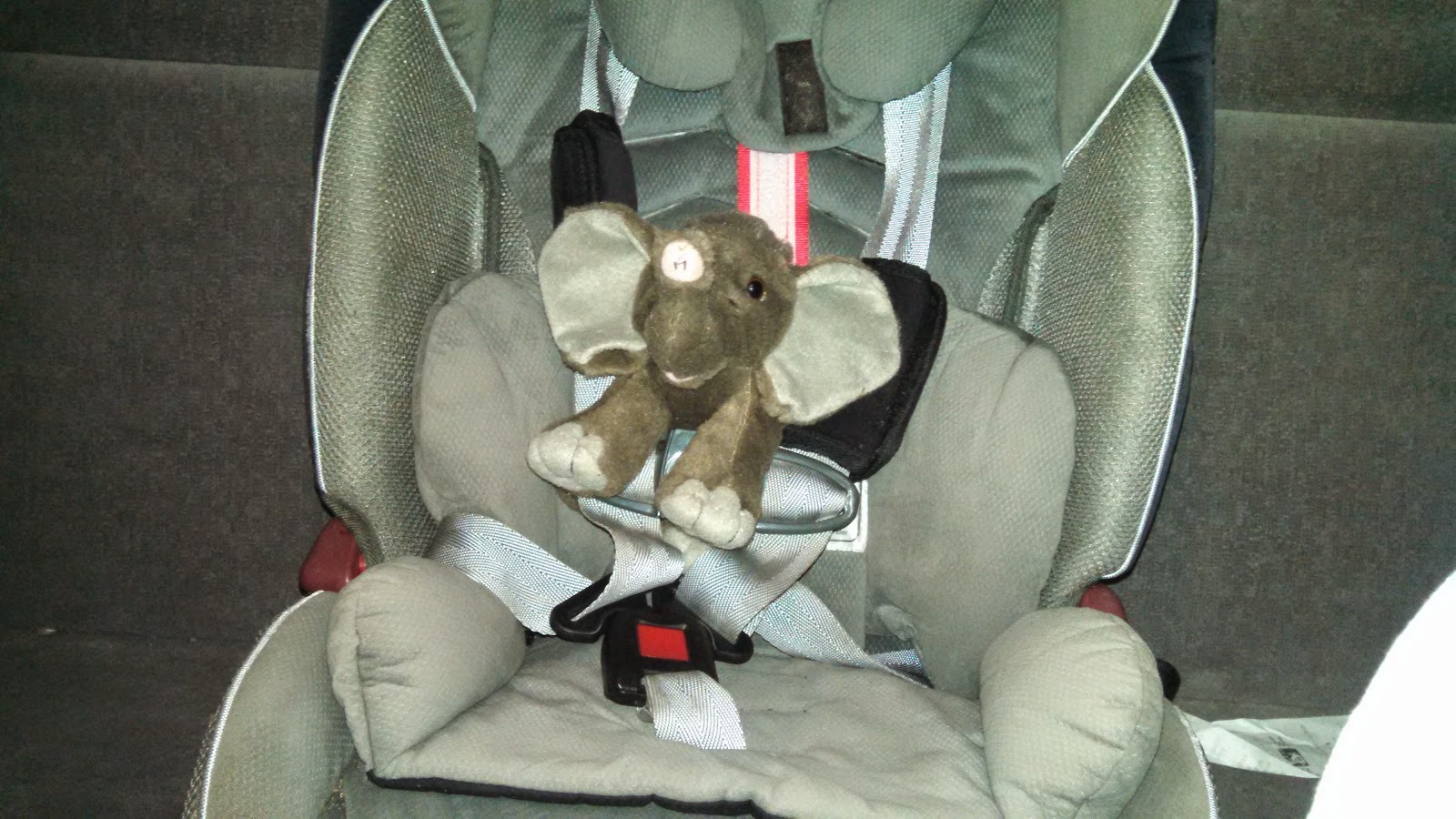
I just had a (very) quick trip to Boston.  Harriet was disappointed that she couldn't go with me, so she sent a representative...

Hati was very excited to get on the airplane with daddy to go to Boston.  What would they find?

In Boston, Hati and daddy went to stay with friends in a nice house. Hati had hummus and ruti and ate angur.

Hati also found good books to read.

When daddy called home to Harriet, Hati sat on Daddy's shoulder to listen to the conversation.

Later, Hati got to ride on the subway with Daddy.

They met some of daddy's friends and ate chocolate and berries to celebrate a paper they had published. Hati got to eat some too.

Then it was time to go back to their room and go to bed.

The next day, Hati went with Daddy to his office. Daddy had a very big computer.

He spent the whole morning talking to people. Sometimes it was interesting and other times Hati was very bored.

At lunch time, they went in a car to another office, where Daddy told people about his project, and Hati got to eat a cookie.

After that, it was time to go to the airport and go back to Iowa.

Finally, Hati and Daddy got back to Iowa. It was very late, and Hati fell asleep in the carseat, happy to be almost home.

Tuesday, November 04, 2014

Heart is the best power

Yesterday at the iGEM awards, I had another massive experience that took me completely by surprise.  This year, they introduced a new award, The Chairman's Award, which is picked by Randy Rettberg (the chair) as the team who best represents the spirit of the iGEM event: curiosity, hard work, intellectual honesty, etc.  When he headed up to give it, as the penultimate award before the top prizes, he told me: "Why don't you come up too... you know the team."

And so it was that I came to be onstage again, once again in front of that massive audience of 2500 genetic engineers from around the world, to shake hands with our wonderful scrappy underdog team from Sumbawa, Indonesia, and give a totally unprepared and off the cuff speech in praise of their outstanding efforts.

I talked about how I was proud and humbled by having them in our new measurement track.
I talked about how, when I spent time talking with them at their poster, they told me "We are new, but we have confidence because have great heart."
I talked about how they were doing real genetic engineering addressing real problems in their local community, at a university that was only one year old.
I talked about how they were worried they could not be a measurement team, because their cell phone cameras could not measure green fluorescence.  We told them a negative result was still a useful result, and they sent us beautiful documentation of the fact that their cell phone cameras measured all the samples the same.
I talked about how they had engaged the local community, teaching honey farmers to pipette and helping them understand synthetic biology and its potential value in their lives.
I talked about how they had gotten religious support for their genetic engineering from the local imam and the local priest.
I'm crying again just writing about it.

I hope that somebody was taking a video, because I'd like to share it with you.  More importantly, however, I want to stop talking, and let you see them explain their project in their own words:

Monday, November 03, 2014

To all my peeps at iGEM

I just gave a scientific talk before the largest audience that I have ever in my life addressed: 2500 synthetic biologists at the iGEM jamboree. In a five minute talk, I told everybody about the gigantic interlaboratory study that we ran this year, including a special shout-out to the team from Sumbawa, Indonesia, who did their measurements using cell-phone cameras because the nearest fluorescence-measurement equipment was 1000 km away.

And what did we get?  From 45 teams in 18 different countries, we got a worldwide baseline and some remarkably good consistency in measurement values:


Next step: write it up and plan for next year's study...

Tuesday, October 07, 2014

Wednesday, October 01, 2014

A triumph of citizen science at iGEM

I recently had one of those rare moments of true elation, a scientific triumph that actually brought tears to my eyes. It's my triumph, but it also belongs to so many more people than just myself, the biggest experiment that I have ever run in my entire life.

Let me back up a bit and explain.  Every year for the past 10 years, there has been a big event called iGEM - a genetic engineering "jamboree" in which undergraduates spend the summer doing synthetic biology projects, then get together in the fall to show each other what they've done, compare results, and compete for who has done the most awesome project and presentation.  It started small, but grew quite quickly, and this year there are on the order of 250 teams participating from all around the world.

Last year, I started talking with the iGEM organizers about the possibility of starting up a new track in the competition, focused on the problems of measurement.  I've never really been interested in measurement as a subject, myself, but I've found that I am getting more and more invested simply from a need to have good data in order to accomplish the things I want to do scientifically.  Putting together a measurement track at iGEM sounded like an interesting idea, and one of the things that made me more interested was the idea that we might ask the teams in the measurement track to participate in an interlab study.  In other words, have a bunch of different labs do the same experiment, so that we could compare data and see how reliable the numbers actually are.  So I put together a nice diverse team of colleagues interested in the idea: Traci Haddock (Boston University) is a close collaborator on precision characterization and genetic engineering, Jim Hollenhorst (Agilent) is a long-time veteran of instrument development, and Marc Salit and Sarah Munro (NIST) are specialists in measurements and standards.  Together we worked with the folks at iGEM HQ, especially Kim de Mora and Meagan Lizarazo, to put a track together.  And then we sat and hoped that people would register.

I was worried we'd have only a couple of teams sign up, and that we'd end in an embarrassing fizzle, but Kim and Meagan kept telling me not to underestimate the iGEM students, and so I kept my fingers crossed.  Almost nobody registered and almost nobody registered... and then the deadline for teams to pick tracks came and suddenly we had 11 teams dedicating their summers to the study and improvement of the science and engineering of measurement.  And the interlab study... well, the best way to show who signed up is to show the map I put together:
Teams participating in the iGEM 2014 Interlab Study
(interactive online version) 
That's 45 teams who signed up, just because they believed that it was important to understand how well we can compare our measurements.  Teams not just from America and Europe, but from all over the world: from Mexico and Colombia and Brazil and Turkey and Kazakhstan and China and Indonesia and on and on. Students who decided to take time away from their main projects, because they thought that this would be fun and important.  Who listened to us and understood, when we explained about the value of repeatability in science, and the importance of building our knowledge on a solid foundation.

So that was the first time that I was blown away.  But we didn't know what would happen when we got the data.  As this was the first year that we did any sort of interlab study, we didn't know what teams would be capable of, what equipment they would have, what cells they would be working with, what knowledge and guidance their supervisors would be able to produce.  So we asked for just a simple thing, to measure three genetic constructs in simple, standard conditions.  We hoped that some teams would be able to do some of the more sophisticated techniques that I have been applying, but knew that they might not be able to.  But we had no idea what quality of data we might actually get.  iGEM is somewhat polarizing in the world of synthetic biology: there are a lot of professors who think that it is wonderful, and who build research programs that are intimately tied with things their students do in iGEM.  Others, including some very high profile researchers, think it's a waste of time and that they can't trust data produced by undergraduates, and won't have anything to do with it.  Me?  I hadn't committed to a position yet: iGEM certainly looked really neat, and I thought the participating students all get an excellent educational experience (which is enough to recommend it right there!), but I'd never been engaged deeply enough to know how sound the science that came out of it was.  Here, as the data came in, I might finally begin to learn.

Saturday afternoon, with data from 2/3 of the teams in hand, Traci and I sat down in a corner of the meeting we were at to find out what we had wrought.  I opened up an Excel spreadsheet and she parsed through the worksheets the teams had sent in to read me out their vital numbers.  The columns filled, and it was clear that some of the teams had gotten reasonable data while others had run into problems---failed cloning or contamination or instrument problems or who knows what.  No surprises there---it would have been surprising if nobody had had trouble. And when we had enough entries in the table, I selected a couple of columns and told Excel to make a plot.

Disappointment scattered itself all over the graph.  Where we would hope to see a nice straight line of points, there was a virtual cloud of incoherence.  Every single graph we tried looked like that: a massive mess of scattered hash.  Looking into the methods sections of the teams' reports, we could see a number of differences, both large and small, and so contented ourselves with the idea that we'd been able to actually quantify just how bad is the effect of lab-to-lab differences in the way that people work with cells and instruments.  Not a bad result, especially for an experiment whose basic aim was to establish a baseline from which to work.

But then... then on the plane back from Boston, I moved the data from Excel to Matlab, where I could really analyze the numbers, and I plotted them again.  And it all lined up.  I had selected the data points to use by a simple rubric for likely validity of the data: are the "high", "medium", and "low" expression promoters in the right order and showing at least some significant difference?  That helped a lot, but even when I included everything, it was nothing like the mess we'd seen before.  I looked again, and discovered that nobody on Earth should ever use Excel to analyze any sort of data.  Those plots that looked so horrible?  That's was because Excel was experiencing an odd bug that caused it to use row numbers for the X axis on the graph rather than the actual values it claimed to be plotting there.  If you replace one of your two variables with arbitrary junk, well of course it's going to be a mess.  But the real data... the real data was so nice.

And that's the thing about science, really, that's sometimes so hard to wrap my head around.  It works.  The universe really does run on rules, and no matter how strange or complicated or hard to understand a thing may be, the substance of reality has no mystical component.  If you can just find the right lever and the right place to stand, everything makes sense, and this fact is indicated by the fact that these points of data make a beautiful line.  It doesn't matter whether we want the result we get or not, and there is no moral implication in the knowledge: what we do about the universe once we understand it is where our humanity comes in.  But even life itself has rules, that we can understand and work with, and this experiment---so simple, yet at the same time so large and complicated---is another step towards doing that.  

What exactly were those results, you ask? Well, I'm sorry, but you're going to have to wait.  We've promised all the teams that we're going to announce the results of the study at the iGEM jamboree at beginning of November, and nobody gets a peek before then.  All I can say for now is: it was worth it, and I am humbled by the remarkable enthusiasm and dedication of young men and women from all around the world who made it possible.

Saturday, September 06, 2014

Creative versus Scientific Writing

I listen regularly to a podcast called "Writing Excuses," about all sorts of aspects of being a professional author of fiction. It has the wonderful tagline, "15 minutes long, because you're in a hurry and we're not that smart."  Of course, the folks on it are pretty smart, but the 15 minute format does well for them I think, because it forces them to focus tightly on the key ideas that they want to communicate and think about, rather than allowing the meandering self-indulgence that I have encountered on many a longer podcast. I listen because one of my favorite authors is one of the podcasters, because I enjoy listening to the banter and their description of an alternate world they live in right beside my own, because it's precisely the length of one bicycle ride to work, and because I find it to be surprisingly relevant to my own professional life and identity.

As a scientist, one of the things I do is that I need to be constantly able to write.  Last year, for example, Google Scholar says that I generated 19 scientific publications, by its somewhat loose standards.  Besides these, of course, there's a number of white papers and proposals and reports and talks and all the rest of the miscellany that comes as part of professional communication.  Those documents span a surprising number of years as well, with the oldest amongst them having been drafted in 2008 and the youngest only a few weeks before its publication.

Together, those 19 publications comprise a total of 214 pages, of which 102 pages and 14 publications are ordinary scientific papers. The remaining five are standards documents or patents, which get rather inflated because they play by entirely different rules of what counts as a good document: a scientific publication must communicate, while a standards document is intended to constrain the bounds of a complex technical activity and a patent aims to noisomely mark the largest possible territory with legal spoor.  Estimating based on the typical density of 500-900 words per page in scientific papers, that's around 66,000 words of ordinary scientific papers (not standards or patents).  The papers average 3.6 authors each, or 3.1 if I exclude those authors who did no writing.  Interestingly, many of the higher-author papers are also shorter, so if I allocate pages by authors on a per-paper basis, I find that about 29,000 words of scientific publication are attributable to me in 2013.

Interestingly, that's actually much smaller than I would have thought, about 1/3 of a typical paperback novel.  When I compare it with writing that I've done in non-scientific contexts, it is actually surprisingly similar.  For example, the last major live-action roleplaying game that I ran---a 10 day long affair called "Harry Potter Year 7: Hogwarts Under Siege"---was about 490,000 words, according to a quick check of the LaTeX source in its repository.  That was written by six authors over the course of two years, meaning about 41,000 words per year are attributable to me.

Apparently, if I were a novelist, I would produce about one paperback every two years.  But I wonder if that's really a fair comparison or not.  It's tempting to say "No, because science..." but then I look at the roleplaying game number, which I had honestly thought would be much higher.  Even that roleplaying game is very dense with research and cross-links, but then, so are many novels.  I think about the authors on that podcast, who also do a lot of careful background research---one is known for his intricate magic systems, another writes fantastically precise period pieces, another does a lot of math in the course of producing good, consistent hard SF.

So honestly, I think that I should view myself as simply a rather pokey writer, by professional writer standards.  My favorite authors are probably all writing about four times as fast as me, if that comparison is something that is actually meaningful.

The real question is: should I care about it?  I'm not sure.  I do think that my writing is less efficient that I would like it to be, and looking at the numbers, I think that there is reason to expect that I should actually care to improve it, if only so that I can spend less time in my "frustrated" stages of writing.  In that sense, I spend a lot of time on certain sentences in a document, while other whole sections go much faster, and much of that time is spent in a certain type of paralysis, going back and forth between two or three ways of presenting the same idea, writing and erasing and rewriting and chopping it up and back and forth and so on.  I'm sure that there are cases where that level of precision can actually matter, but certainly not at the first draft stage.

The writers on the podcast that I listen to will often say, "Writing is what defines a writer. If you write, then you are a writer."  Just write.  Put it down, correct it later.  Some exercises for myself, I think... dear readers, I will let you know how it goes.

And, hmm. This was not the direction that I expected to go when I had started to write this morning.  I suppose that this is one of the charms of scientific writing, even in a casual and informal venue such as this.  No pre-publication peer review to put out these ~900 words, however, just the post-publication review of comments and who out there finds it actually interesting enough to spend their precious time to read.  And now, in honor of my drifting topics:
Harriet, already prepared for receiving scientific reviews.

Tuesday, September 02, 2014

The Engineers' Song (clean version)

As I wrote in my last post, I found it quite unexpectedly distressing that I couldn't teach the Engineer's Drinking Song to my two-year-old without feeling rather much uncomfortable.  Now, maybe this shouldn't have surprised me at all, I mean, it is a drinking song and says so right there upon the title. But what I really like about it is the catchy tune and upbeat rhythm, which contrast quite strongly with the misogynistic and self-hating nature of the lyrics.  Have a listen and see: this video is about as clean as it gets, being performed for prospective students and all.  And I suppose that this is all to be expected from a drinking song originally from the military and then adopted by stressed out undergraduates, both of which are groups highly invested in being crass for different reasons.  I can appreciate a good bit of crassness myself, but it has its places and times, and singing to toddlers is not one of them.

But I'm really proud to be an engineer, and I think that it would be nice to have a version of that catchy tune that's positive and celebrates the things I value about my life as an engineer, and that I'd like to pass on for another generation. And so, dear readers, in the spirit of Broader Impacts and promotion of STEM field education, I present the following revised collection of lyrics, and in the spirit of our tinkering lives, I invite you all to suggest lyrical improvements, additional verses, and to spread it to the winds:

The Engineers' Song (clean)

Chorus:
We are, we are, we are, we are, we are the Engineers 
We can, we can, we can, we can, make anything with gears
Computers, lasers, DNA, just come along with us,
'Cause anything that we can dream, we'll build without a fuss

Verses:
An engineer's an engineer from when she first can talk,
While other kids look on with awe, she's stacking up the blocks
The simple phrase "How does it work?" sets fear in parents' hearts
"Go hide the drills and screwdrivers, she'll take it all apart!"

Grace Hopper was the first to tame computers to our will
By making up compilers that let any Jack or Jill
Build network applications at a wild frenetic pace
So any time you use your phone you'd best remember Grace

When someone hires an engineer they know what they will get
A bunch of smarts and knowledge and a willingness to bet
But supervise them carefully and check what they have done,
'Cause otherwise the engineer will just build something fun

Oh, Tesla was an engineer of electricity
with coils and sparks and deathray plans as far as you could see
And when his rival Edison had lost the current war,
Well, Telsa just went to back to work on radio and more

A barbeque was going fine 'til someone dropped a match,
And set off an explosion from where lighter fluid splashed
While everybody else had panic running through their brain
The engineer said "Get some more and let's try that again!"

In great New York the Brooklyn bridge was rising every day,
The old man who'd designed it had just died and passed away
So Emily Roebling stood up and she said, "It's not so hard,"
"I've an engineering spirit, never mind what's on my card."

An engineer and sales rep were a-walking in the park,
The sales rep pitched a product that he thought would be a lark
The engineer was skeptical until he set her right,
And told her that the product would have lots of blinking lights

An engineer retired after a long and full career
Her husband asked her afterward "What will you do now dear?"
She turned back to her husband with a smile lit like the sun
"My love you know, now I'll have time to get some real work done."