Saturday, March 21, 2015

A spectre is haunting me in Huntsville

Having recently had great fun watching a satellite launch in Cape Canaveral, we decided to spend this spring break visiting the US Space and Rocket Center in Huntsville, Alabama.  Unlike Cape Canaveral, Huntsville is a plausible driving distance from Iowa City, at about 10 hours on the road, which made it a much better option than competing for airline seats at spring break fare levels.  Huntsville isn't quite so beautifully warm and spring-like as we'd thought it would be---apparently Northern Alabama has a lot more climatically in common with the Midwest than the Gulf Coast.

From our hotel, you could see the giant Saturn V moon rocket (mockup) looming up over the trees, and overall, the museum did not disappoint.  Harriet did space-walk dances beneath the shuttle, and delighted in the "blast-off ride" for little kids that shot them up in the air and then bounced them up and down and up and down on their way back to the ground.  She also loved the recordings of the Saturn V engine tests, which shook the whole area around where they played.
Harriet on her highly-favored "blast-off ride"
The Space and Rocket Center is also where Space Camp is, and so all the time that we were there, we were surrounded by floods of school-kids of various ages, going from place to place, learning the history of space and rocketry, doing experiments with balloon-and-cardboard landers or hand-launched rockets, learning about reorientation training by being spun around in giant hoops, and generally being highly enthusiastic at the top of their lungs.
Learning about space beneath the Saturn 1B
Reorientation training in a three-axis tumbling machine
I found, to my surprise, that my feelings were much more mixed than they had been in Cape Canaveral.  The thing is, the Space and Rocket Center is quite conscious of its history of being just as much about rockets as space.  This is where von Braun and the rest of the Nazi scientists from Operation Paperclip were brought to continue their work, and the collection also includes V-1 and V-2 terror weapons, quite a number of US military missile systems, and even an attack helicopter from the Vietnam era.  Walking through the museum entry, after you pass the case of model space shuttles and the "Mars Climbing Wall," you confront a bunch of Army future combat system prototypes and publicity models: a humvee with some sort of laser targeting pod, air and ground combat drones, air-to-air missiles, storm-trooper mannequins in badass green camouflage.
Learning in the shadow of  a V1 "Buzz-bomb"
Army surface-to-surface missile systems
I shouldn't be uncomfortable with this, I think.  I'm basically OK with the idea of military systems, used responsibly, and my research is mostly funded by the military.  So why did it bug me to have such a fusion of space and military, to find that overhead there seemed to be practically always a military helicopter passing by in some direction on an errand in the sky?  Clearly, the people of Huntsville did not have any such qualms.
One of the ubiquitous overhead military helicopters
So why was it this way for me?

I think that I want to feel that our venture into space is part of the best part of humanity, the reach after better dreams and visions.  It is in space where we first truly learned to look back on the Earth and to learn how fragile and unified it is, a gut-level grasp of the meaninglessness of national division.  Seeing the Earth from space helped to kick-start environmentalism, and to get us past the Cold War.  So I want space to be tied into that well-spring of good things, feelings I can rightfully feel warm and fuzzy about.

Military technology, on the other hand, while I feel it is reasonable and necessary, I also feel reflects the worst aspects of human nature.  We need these types of technology because we haven't figured out any way to have a society (or system of societies) in which there is not also conflict and strife.  So we need safety and defense, and defense can so easily become offense and oppression and war.  Even now, living in the safest period of human history, we are killing one another, and our high technology does nothing ultimately to change that fact, and indeed can enable us to become more callous and distanced from the effects of the choices we make as a society.

At Kennedy Space Center, the military side of space is not particularly visible, and neither is the nationalistic side.  It has all been brushed under in favor of the international and positive side, the aspirations that drive one major side of the drive to orbit and beyond.  The crowd is international, and the tone is of a united humanity.  But the satellite launch we watched while we were there was a US military communications satellite, and its existence actually directly impacts the scenarios that I am working with in my research now.

In Huntsville, you know that the two are intertwined, and you know that they are proud that it was the United States that went and did these things.  They aren't shy about von Braun's Nazi past.  They don't hide the fact that we performed animal testing before we ever sent humans up: in fact, there is a very uncomfortable-looking mannequin of a monkey restrained in a complex steel contraption, to show just how Able and Baker were sent up on their historic flight.  I also eat meat.

I know that I'm not comfortable with this intertwining of dreams of a better civilization with the realities of military use, but that doesn't mean it is or was the wrong thing to do.  In fact, I know that in fact it may be best to have a person like me who is uncomfortable involved, because I am not going to take the morality of the research that I am involved with for granted.  Or at least I hope that can remain the case.  I sometimes wish I didn't have to see the truth, but not to see it would be worse, I think.

Our visit to Huntsville haunts me, and I am comfortable with that.
Saturn V: the dream at dusk

Thursday, March 12, 2015

The secret to avoiding jet-lag on red-eye flights

OK, folks, here it is: the secret to avoiding jet-lag on red-eye flights.  I learned this from Patrick Winston, who claimed to have learned it from his time serving as a research advisor for the US Navy. The US military, of course, has a deep interest in all things related to sleep, including jet lag, and has invested quite a bit into learning how to best manage it over the years.  The bit that I remember, and have successfully deployed on many occasions, is this:

First, you must understand the principle: your body keeps its circadian rhythm entrained with the cycle of day and night by having a natural rhythm that is slightly longer than a day, and resetting it on encountering bright light in the morning.  Artificial bright light, however, is all around us, including in the LCD screens that dominate our modern environment.  So when you stay up late in artificial light, that makes your body think the day is longer, and drag you "Westward" in your rhythm.  Red-eye flights, however, are generally East-bound, and so if you follow the natural course and try to stay up, your body thinks it is a super-long day, runs out of patience and tries to put you to sleep in the middle of the day, gets very confused, and you end up completely screwed up with jet-lag.

Instead, you want to convince your body that it is a super-short day.  For this, you need to shut out all light, so you need one of those sleep blinders.  It doesn't need to be fancy, just to shut out the light and be sufficiently comfortable that you can keep it on all night without ever removing it: you can generally get a decent one for less than $10.

As soon as you get on the plane, get comfortable, buckle up, and put on the blinder.  Do it before takeoff.  Skip dinner, skip the movies, and don't take the blinder off until you smell breakfast.  Just relax and rest---sleep if you can, but resting will do OK even if you can't sleep, and you'll probably drift in and out.  Your body, deprived of light, will think it's a short day and move your rhythm "Eastward"---not all the way, but enough that you won't have to fight sleep in the middle of the day, can be quite functional immediately, and will be fully adjusted within another day or so.

I find this works quite well, and have added one more filigree of my own: I go stir-crazy if I'm sitting in the dark but not asleep, so I need something to occupy my mind.  For that, I listen to audio books, and in particular, on a red-eye flight, I always listen to an audio book that I have already listened to, preferably multiple times.  This does two important things for me: 1) it's not new for me, so it's not exciting enough to stay awake for, and 2) I can have a vague sense of how long is left in the flight without looking by the progress of the story.

With audio books and a blinder combined, I find that I can manage pretty much any red-eye comfortably and effectively, with minimal jet-lag, and I strongly recommend them to you as well.

Good luck, and happy traveling!
Chicago O'Hare airport at dawn

Wednesday, March 11, 2015

Cutting it Close

"If you've never missed a plane, then you are spending too much time in airports."  This was a saying about travel that I have come to appreciate, which I heard from Patrick Winston, one of my graduate advisors. He is also the one who taught me the secret of avoiding jet-lag on overnight flights, so I take his advice quite seriously.

So far, I am still apparently spending too much time on airplanes, but today was closer than I've ever been before, leaving MIT at 4:50pm to catch a 5:55pm flight at Boston Logan.  Fortunately, traffic wasn't too bad, and I even had 5 minutes at the gate before I boarded, but it reminded me why I do still spend more time in airports than Patrick would suggest: the cost of missing a flight and getting home too late is just too much for my preference.  These days, I err instead on the side of shaving things close in my presence at meetings, and omit the time I might have allocated for touring or getting to know my environment, because I don't want to spend the time away from home and those I love.

How young is too young to fly with me to a conference?  I don't yet know, and I'm not sure I'd want to put Harriet through the absolute boredom that my packed traveling days would generally entail on her behalf (I never even get full nights of sleep when I'm traveling professionally), but I keep thinking about it, and trying to figure out when and how I can make it sane for her to join me and get to see the world as her father does.

Sunset takeoff at Boston Logan

Friday, January 30, 2015

Peripatetic Science

Some things you don't really fully realize until they are all put together in front of your face. Filling out some (exceedingly tedious) forms today, I had to write down all of the foreign countries that I have visited recently, and apparently, over the past five years I have gone abroad 27 times, to 14 different countries.  The vast majority of that travel has been for scientific meetings of one sort or another, and mostly to various locations in Western Europe.

I know that I travel a good bit for science, and part of me looks at that number and says, eh, that's only about once every quarter.  The other part of me, the part that remembers a quiet childhood growing up in Maine, almost never traveling more than a few hours drive from home, looks at those numbers in astonishment.  It means that I have grown up to become one of those strange frequent fliers, for whom an airport is just a normal part of life, and I suppose that is how it will continue to be for as long as I am a practicing scientist.

I like this life, but sometimes it helps to remember how foreign it is to many others, and even my own younger self, who not only didn't know I would end up living such a life, but never even thought about the possibility.

Sunday, December 14, 2014

Discovering Luxembourg

I think that I am falling in love with the architecture of Luxembourg.  This morning I have spent mostly walking around the streets of the city, with its curious mixture of old and new, and I am being continually taken in by the drama and beauty of the place.  My hotel was right in the center of the city, and the city itself is quite compact: a hill surrounded by deep and defensible valleys, now bridged with great stone and concrete viaducts that carry highways and rail lines.

The streets in many places are nearly as narrow as Venice, but with high 18th century-style buildings more reminiscent of Paris.  Even the newer construction often seems to have chosen either to fit in or to coherently and deliberately depart (and there is quite a bit of new architecture, Luxembourg having apparently been rather damaged in the tail end of World War II).  Moreover, since the center is much more compact than either Paris or Venice, all these things combine to create a city where even a short walk turns around many corners of surprises, dramatic angles formed of the corners and confluences of little wriggling streets.  At the edge of the hill, the city drops off sharply, with steep stairs and roads plunging down into the parkland of the river valley.  Along the side of the valley are old castles, pastel-colored stone houses marching down the side of the slope, and even homes driven into the rock itself.  On the far side rise cranes and the glass towers of the country's industry, though I'm not sure whether those particular towers hold banking or software or European government.

It is a rather international city as well, as befits a small country that attempted neutrality for a long time, then after its experience in World War II turned about and fiercely embraced the new order that it helped to create, as one of the founders and agitators for both the European Union and NATO.  I walked along a major road named Franklin D. Roosevelt Boulevard, and not far away is another street named for John F Kennedy. I hear many languages in the streets, and see at least at least a smattering of cross-cultural couples.  Nearly every advertisement that I have seen has something to do with the way the country sees itself as a crossroads, a place not on its own, but defined through its connections with the rest of the world.  Luxembourg intrigues me, and I need to come here again with more time to spend.


Now, I am sitting on the steps of a public building on the edge of one of the city squares, listening to blacksmiths pounding out ornaments in the bustling Christmas market in front of me, and amazed to find myself automatically online (perhaps it is the university) so I can even upload this post while it is fresh on my mind.  Good job, Luxembourg: yet another way I like you.

Saturday, December 13, 2014

International Showers

Somewhere, inside pretty much every international airport, there is a place where you can get a shower.  Sometimes they are public and anybody can get at them; other times you have to get access to one of the airline lounges, either by being a frequent flyer or paying for a day pass.  If you can get at that shower, though, it can make a world of difference.  Last night, before getting on my overnight flight from Miami to London, I got a shower in the American Airlines lounge, making up for not really being able to clean my hair properly for the last week.  Then, while waiting to connect in Heathrow, I got another shower in the British Airways lounge, and washed away all of that red-eye flight nastiness that builds up when you've spent a night neither really sleeping nor not sleeping.  In both showers, the water temperature was kind of unstable (each in its own special way), but who cares: it was a few minutes of perfect quiet solitude and self-care, and by the time I stepped out, I was clean from my toes to my teeth and with a much more settled and stable mind, ready to face the next step of my voyage.

Thursday, November 20, 2014

Hati goes on a trip

I just had a (very) quick trip to Boston.  Harriet was disappointed that she couldn't go with me, so she sent a representative...

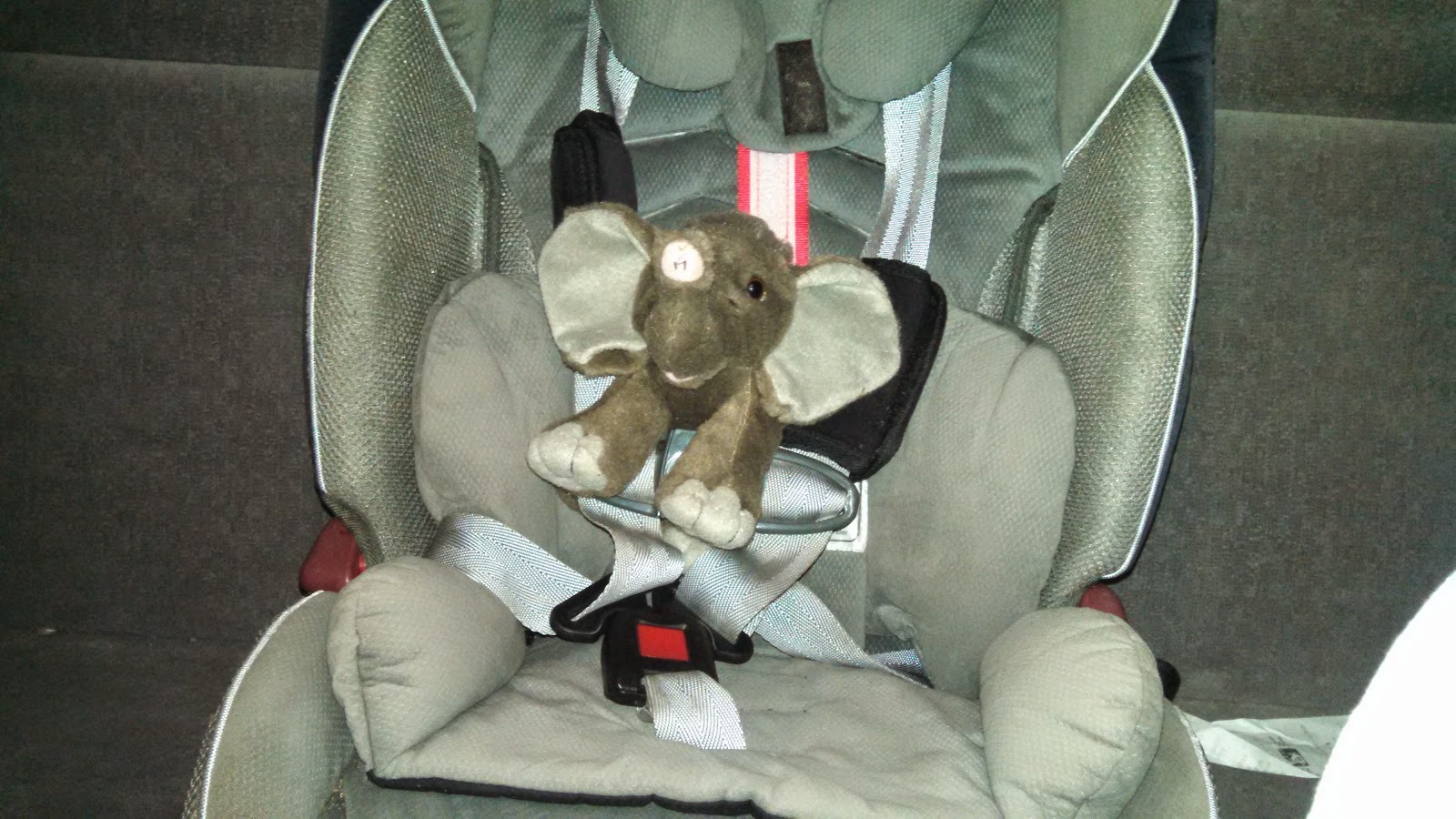
Hati was very excited to get on the airplane with daddy to go to Boston.  What would they find?

In Boston, Hati and daddy went to stay with friends in a nice house. Hati had hummus and ruti and ate angur.

Hati also found good books to read.

When daddy called home to Harriet, Hati sat on Daddy's shoulder to listen to the conversation.

Later, Hati got to ride on the subway with Daddy.

They met some of daddy's friends and ate chocolate and berries to celebrate a paper they had published. Hati got to eat some too.

Then it was time to go back to their room and go to bed.

The next day, Hati went with Daddy to his office. Daddy had a very big computer.

He spent the whole morning talking to people. Sometimes it was interesting and other times Hati was very bored.

At lunch time, they went in a car to another office, where Daddy told people about his project, and Hati got to eat a cookie.

After that, it was time to go to the airport and go back to Iowa.

Finally, Hati and Daddy got back to Iowa. It was very late, and Hati fell asleep in the carseat, happy to be almost home.

Tuesday, November 04, 2014

Heart is the best power

Yesterday at the iGEM awards, I had another massive experience that took me completely by surprise.  This year, they introduced a new award, The Chairman's Award, which is picked by Randy Rettberg (the chair) as the team who best represents the spirit of the iGEM event: curiosity, hard work, intellectual honesty, etc.  When he headed up to give it, as the penultimate award before the top prizes, he told me: "Why don't you come up too... you know the team."

And so it was that I came to be onstage again, once again in front of that massive audience of 2500 genetic engineers from around the world, to shake hands with our wonderful scrappy underdog team from Sumbawa, Indonesia, and give a totally unprepared and off the cuff speech in praise of their outstanding efforts.

I talked about how I was proud and humbled by having them in our new measurement track.
I talked about how, when I spent time talking with them at their poster, they told me "We are new, but we have confidence because have great heart."
I talked about how they were doing real genetic engineering addressing real problems in their local community, at a university that was only one year old.
I talked about how they were worried they could not be a measurement team, because their cell phone cameras could not measure green fluorescence.  We told them a negative result was still a useful result, and they sent us beautiful documentation of the fact that their cell phone cameras measured all the samples the same.
I talked about how they had engaged the local community, teaching honey farmers to pipette and helping them understand synthetic biology and its potential value in their lives.
I talked about how they had gotten religious support for their genetic engineering from the local imam and the local priest.
I'm crying again just writing about it.

I hope that somebody was taking a video, because I'd like to share it with you.  More importantly, however, I want to stop talking, and let you see them explain their project in their own words:

Monday, November 03, 2014

To all my peeps at iGEM

I just gave a scientific talk before the largest audience that I have ever in my life addressed: 2500 synthetic biologists at the iGEM jamboree. In a five minute talk, I told everybody about the gigantic interlaboratory study that we ran this year, including a special shout-out to the team from Sumbawa, Indonesia, who did their measurements using cell-phone cameras because the nearest fluorescence-measurement equipment was 1000 km away.

And what did we get?  From 45 teams in 18 different countries, we got a worldwide baseline and some remarkably good consistency in measurement values:


Next step: write it up and plan for next year's study...

Tuesday, October 07, 2014